Law, morality and constitutional jurisprudence
DOI:
https://doi.org/10.71206/rapc.433Keywords:
law, morality, Constitutional justice, Constitutional Court, positivismAbstract
Classical positivism relied on the sharp separation between law and morality. The current, “inclusive” version admits that in the judicial task non-positive elements come into play; but, far from considering them legal, perhaps by an unconfessed categorical imperative -before dying that seems iusnaturalist- he qualifies them as morals. With this he denies the distinction between a right, as an ethical minimum indispensable to make possible a proper coexistence, and the maximalism proper to any moral approach. He alludes to two, very different judgments, of which he was speaker: the conscientious objection of a pharmacist, who refuses to dispatch a pill he considers abortive, and the frustrated request by a mother of her fetus subjected to abortion, to part with him along with her partner. In both cases, a concurrent vote was cast, for being in favor of the protection, but not for its legal grounding.
Downloads
Global Statistics ℹ️
|
3
Views
|
0
Downloads
|
|
3
Total
|
|
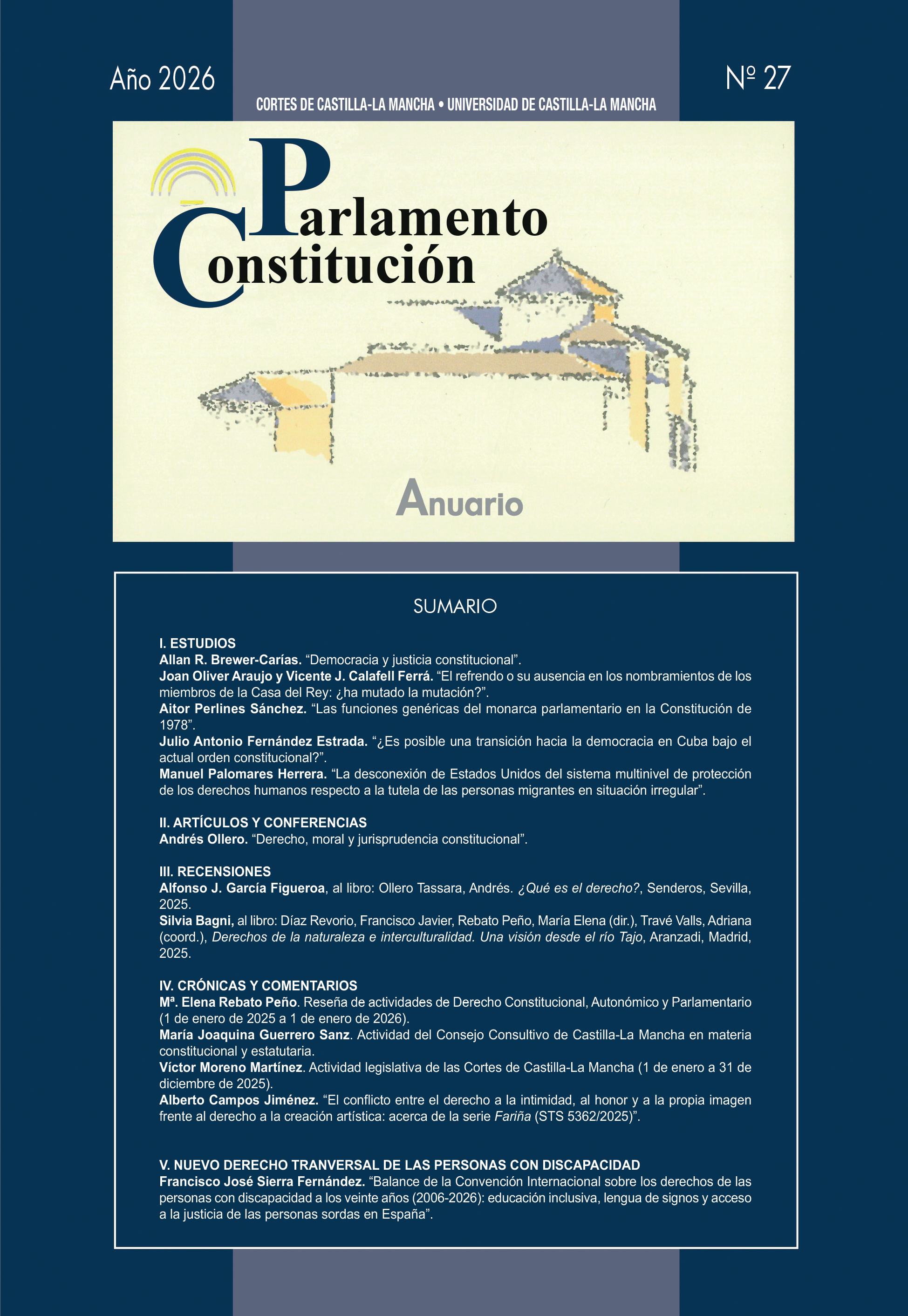
Downloads
Published
How to Cite
Issue
Section
License
Copyright (c) 2026 Revista Anuario Parlamento y Constitución

This work is licensed under a Creative Commons Attribution-NonCommercial-NoDerivatives 4.0 International License.